Two independent public builds and a private application in development. Each study explains the implementation and the evidence available for review.
E. Santiago Paz
Mechatronics Engineer · AI & Software Engineering
I develop software applications, AI-enabled solutions, and enterprise integrations.
My technical experience includes enterprise software, APIs, integrations, Power Platform, Dynamics 365, Dataverse, and process automation. My current projects explore AI agents, LLM applications, and machine learning.
I collaborate remotely on projects with agreed scope, deliverables, milestones, and technical reviews.
Information arriving as free text needs a clear route, an accountable decision and a recoverable failure path.
Solution
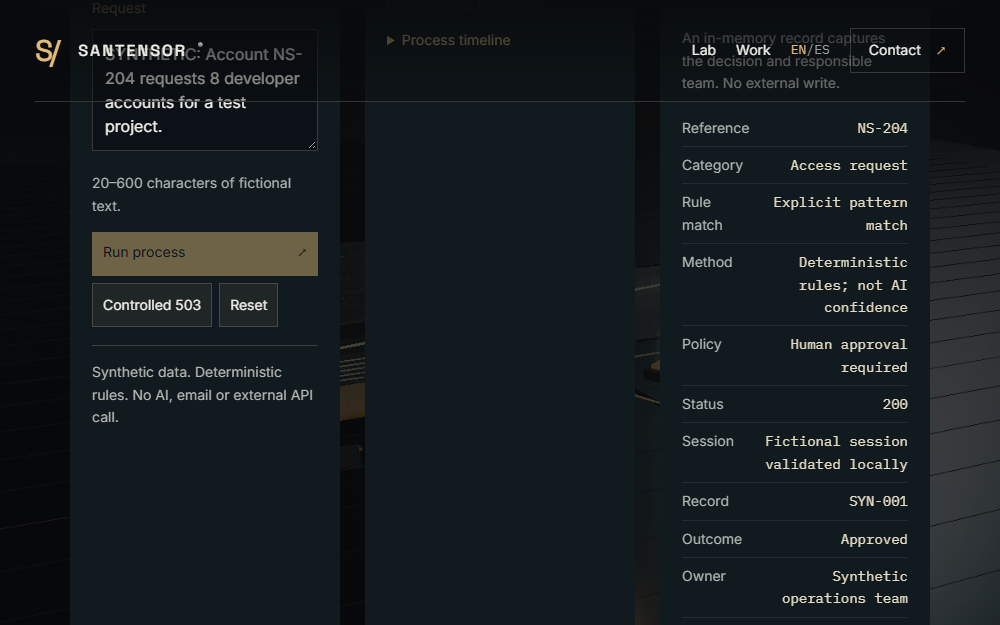
An editable browser laboratory classifies fictional requests, checks a local directory and asks a person to approve, reject or route the request manually.
Technical contribution
A six-stage state machine, guarded transitions, recoverable service errors and downloadable event snapshots.
Architecture & decision
Extraction, policy, tool response and review are separate stages. An uncertain request cannot pass the approval guard. A simulated 503 can be inspected after recovery.
Evidence
Run the demo, inspect a completed event or download its JSON trace. Public source and automated tests show the transition rules.
Limitations
Uses deterministic rules and fictional data, without model inference or writes to business systems.
02 / SOFTWARE & SYSTEMS
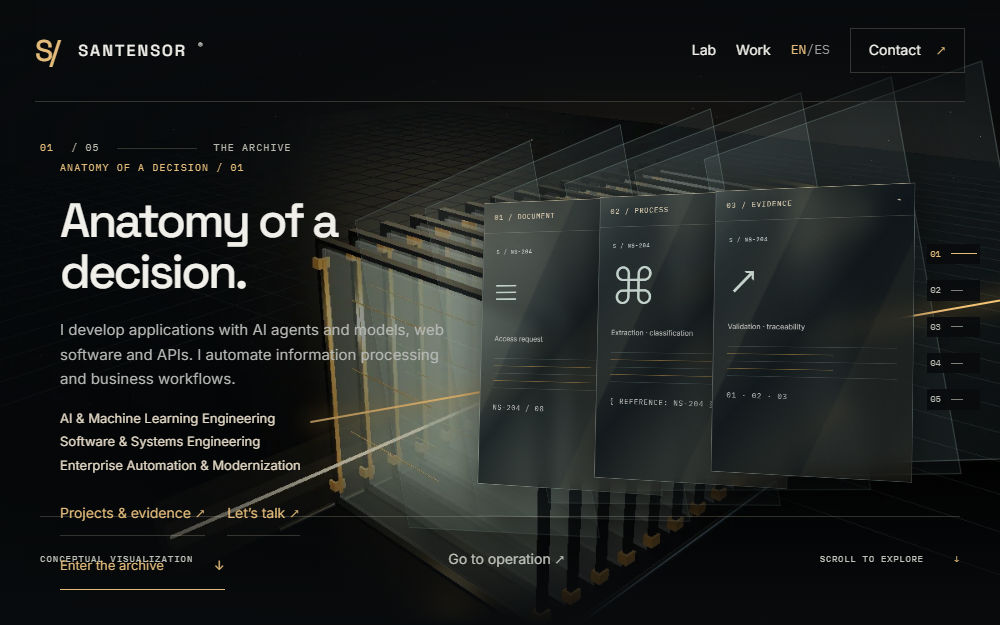
A cinematic, bilingual engineering portfolio.
Public website
Problem
A visual portfolio must explain services while keeping a complex interactive demonstration accessible.
Solution
A static EN/ES website with five continuous scenes, an executable simulator, public project evidence and direct email contact.
The interface works independently of WebGL. Original rendered stills provide a lighter 2.5D mode. A static build keeps the public site independent of an application backend.
Evidence
Explore the five scenes and inspect the public implementation and architecture notes.
Limitations
Graphics adapt to browser support. Physical-device accessibility and GPU performance remain to be validated.
03 / AI APPLICATION SOFTWARE
A private technical interview practice app.
Product in development
Problem
Technical interview practice needs questions related to a role and controlled handling of session content.
Solution
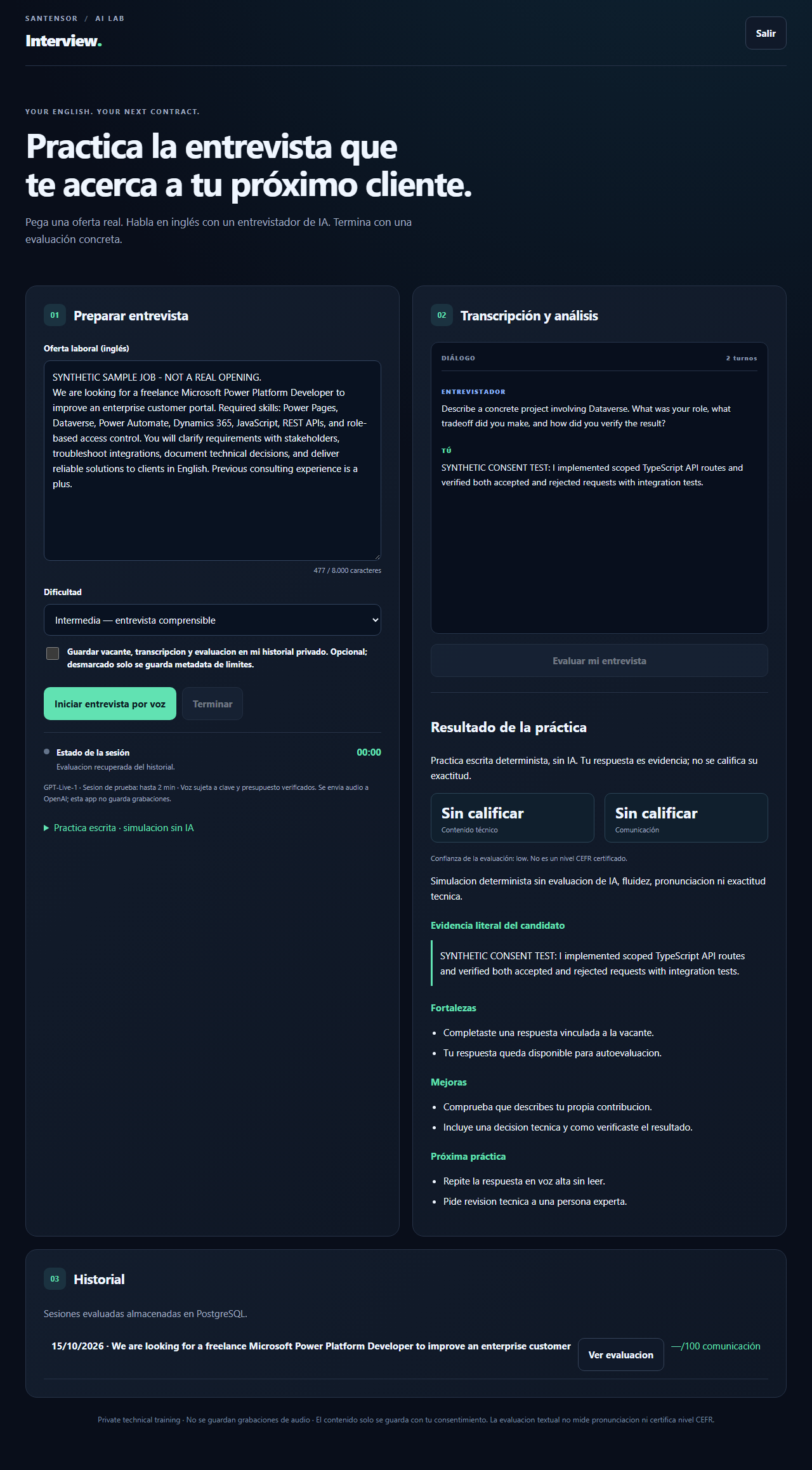
A private application with written practice, an AI voice-session integration and optional history.
Technical contribution
Session access controls, server-side credentials, usage limits, consent for persistence and voice-session lifecycle handling.
Architecture & decision
A Next.js application separates browser interaction, server endpoints and PostgreSQL persistence. Voice transport uses WebRTC; the server mediates the session connection.
Evidence
An existing synthetic practice screenshot and technical review document the implementation. The application remains private.
Limitations
Voice has been tested with synthetic audio and browser simulations; physical audio and evaluation usefulness remain unvalidated.